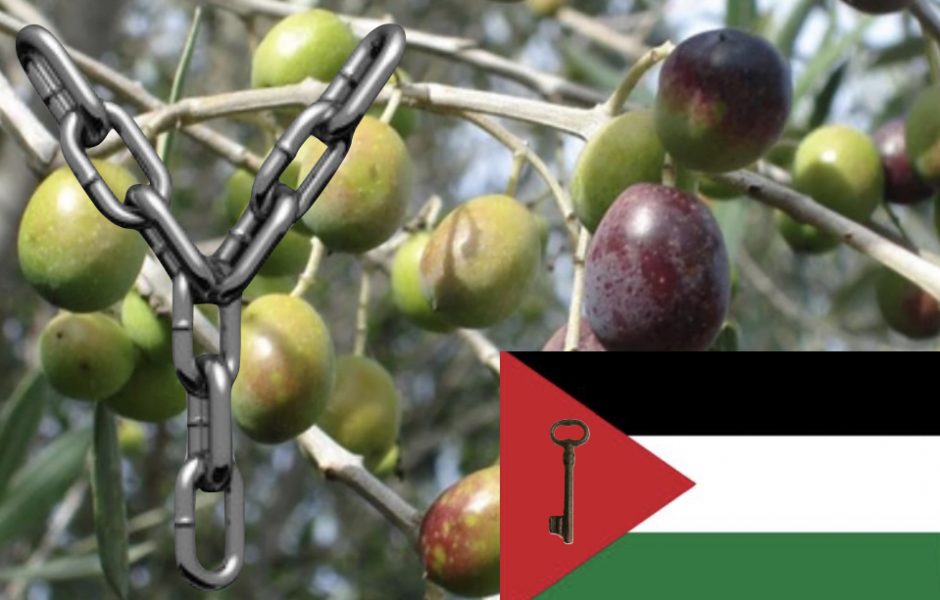
We stand firmly against injustice in all its forms. Nothing can justify the current war crimes committed by Israel in occupied Palestine. Equally, nothing can excuse the continued support offered by other nations to this apartheid regime. If you believe in human rights, dignity, and justice, then we urge you to boycott this rogue state. Silence is complicity, do what’s right.
The British-Australian Jewish actress Miriam Margolyes said that “the one who has won in Gaza is Adolf Hitler,” the leader of “Nazi” Germany, because “he made us like him — killing a defenseless people who have no guilt for our Holocaust in Europe.”
The episode showed a video clip of the Jewish actress saying:
“Because I know the extent of the evil and cruelty that befell the Jews in my lifetime, I cannot bear to think that my people are doing exactly the same thing to another nation. And the people to whom this is being done are the Palestinians.”
She added that the Palestinian people were not responsible for what she called “the Holocaust” and had nothing to do with it.
Miriam continued: “I think the terrible thing I have to face is that Hitler has won… He changed us and made us become like him.”
The host of the program “Fawq al-Sulta” (Above the Authority), Nazih Al-Ahdab, commented on the actress’s statements, saying that “the words of Miriam Margolyes are more valuable and profound than all the studies and analyses that could be written about what happened in Gaza.”
The ill-fated Balfour Declaration, issued in November 1917, remains a contentious historical document that significantly impacted the Middle East. Crafted by British Foreign Secretary Arthur Balfour, the declaration expressed support for the establishment of a “national home for the Jewish people” in Palestine at a time when Palestine was still under the British mandate. However, its implementation led to a series of conflicts, massacres, and disputes, resulting in the forced displacement of hundreds of thousands of Palestinian people from their villages and cities in 1948. The promise made by the British government failed to consider the rights and aspirations of the Palestinian majority population already residing in Palestine, leading to decades of tensions and hostilities. The Balfour Declaration stands as a symbol of racism (white supremacy) and an ill-fated event that Palestinians consider a catastrophic episode in their lives.
Who wouldn’t be happy to have their home unexpectedly handed over to someone else as a generous gift?! How generous it was for someone to arbitrarily pledge a “national home for the Jewish people” in a land already rich with diverse and vibrant communities.
Surely, Balfour’s legacy will remain a dark spot in the annals of time.
For centuries, the great powers of Europe—Britain, France, Belgium, Spain, Portugal, Germany, Italy, the Netherlands, and later the United States—swept across Africa, Asia and the Middle East with armies, missionaries and merchants. Behind the banners of “civilisation” and “progress,” they invaded, occupied and partitioned lands that had their own rich histories and political systems.
The record is brutal.
• In the Congo Free State, millions perished under King Leopold’s private regime of forced rubber extraction.
• In India, British economic policies contributed to famines that killed tens of millions in the 18th and 19th centuries.
• In Algeria, Kenya, Vietnam, Indonesia and elsewhere, uprisings against colonial rule were met with massacres, scorched earth tactics, and concentration camps.
• The Sykes–Picot Agreement and similar deals carved up the Middle East into artificial states whose borders still fuel conflict.
Raw materials—gold, diamonds, oil, cotton, spices, labour—were shipped to Europe and North America to fund the industrial revolutions that made these states the richest and most powerful in human history. Colonies were left with shattered economies, distorted borders, and political systems designed to divide rather than unite.
After Independence: The “Invisible Empire”
Formal empires collapsed after World War II, but the structures of control endured.
• Western powers propped up friendly dictators, armed rival factions, and toppled governments that resisted Western economic or strategic interests.
• Structural adjustment programmes from the IMF and World Bank kept many post-colonial economies tied to foreign creditors.
• Weapons and covert funding turned local disputes into civil wars, while global corporations continued to extract oil, cobalt, coffee, and rare earths.
The Great Reversal
Ironically, the same countries that devastated the global South became beacons of opportunity. Their wealth—built on centuries of plunder—created welfare systems, strong currencies, and technological innovation. For people trapped in poverty or war, migrating to Europe or North America often meant the difference between survival and despair.
Yet migrants arriving in London, Paris, Berlin or New York were no longer “subjects of empire.” They were immigrants, labelled outsiders and often met with racism, discrimination and political scapegoating. They cleaned hospitals, drove buses, and staffed essential industries, while hearing lectures about “integration,” “freedom,” and “democracy”—values long denied to their own ancestors.
Accident or Strategy?
Was this a master plan? Did imperial powers deliberately devastate other regions to ensure permanent dominance and a captive labour force?
Historians debate intent. Some argue it was calculated economic design: monopolise resources, impose dependency, and reap profits for generations. Others see a series of opportunistic decisions driven by short-term greed, not a grand conspiracy.
Either way, the outcome is clear:
• The wealth gap between former colonisers and former colonies remains staggering.
• Borders drawn in colonial capitals still ignite wars.
• Migration flows continue to follow the old imperial trade routes.
The Moral Question
Western governments now position themselves as global arbiters of human rights and democracy. They condemn coups, corruption, and war crimes abroad—often in countries destabilised by their own historical actions. Migrants, despite enduring racism and exclusion, still find these societies more liveable than the homelands left fractured by colonial rule.
This is the great paradox of the modern world:
Those who broke the global South now hold the keys to its escape routes.
Whether this was a deliberate “master plan” or the long shadow of empire hardly changes the lived reality. The descendants of colonisers live in nations built on extraction and violence; the descendants of the colonised navigate a world order still tilted against them, yet often choose to build new lives in the very capitals that once ruled their ancestors.
History may not offer a tidy conspiracy, but it does reveal a system: conquest, exploitation, enrichment—and then the power to define morality itself.
As of this writing, over 20,000 children have been killed in Gaza. Among them are 1,000 infants — babies who never had a chance to take their first steps or speak their first words. This is not a tragedy that unfolded in darkness. It happened in full view of the world — livestreamed, documented, undeniable. And yet, the response from global leaders has been an appalling silence, broken only by carefully crafted statements of “concern” that mean nothing to the slaughtered.
The world has failed Gaza. Not through ignorance, but through moral cowardice and political calculation.
A System Built to Protect the Powerful
If the killing of twenty thousand children had been committed by any other state, the reaction would have been immediate and severe. Sanctions, travel bans, arms embargoes, and international trials would follow. Yet Israeli apartheid and occupation , shielded by its Western allies, continues to enjoy full diplomatic, economic, and cultural privileges.
It still competes in football tournaments, Eurovision, and global sporting events — spectacles meant to celebrate peace and unity. The hypocrisy is grotesque. A nation accused of grave breaches of international law continues to sing, play, and trade as though nothing has happened.
The “rules-based international order,” so often invoked by Western governments, has been exposed as a selective fiction. Rules apply only to the weak, never to the well-armed or well-connected.
Western Complicity
The governments most vocal about democracy and human rights have stood by, providing weapons, diplomatic cover, or strategic silence. Washington continues to send military aid. European capitals, while shedding crocodile tears, refuse even the mildest sanctions. Some have gone further, criminalizing protests, censoring journalists, and intimidating those who dare to call the genocide what it is.
The message is unmistakable: the lives of Palestinian children are negotiable — expendable collateral in a geopolitical alliance.
The Failure of International Institutions
The United Nations, paralyzed by American vetoes and political cowardice, has become a theatre of impotence. Humanitarian agencies have been bombed and starved of funds. War crimes investigations stall. The International Criminal Court moves at a glacial pace, hesitant to anger powerful states.
Every structure designed to prevent mass atrocities has either collapsed or been corrupted. The moral infrastructure of the post-war world — the Geneva Conventions, the UN Charter, the principle of universal human rights — lies in ruins in Gaza’s rubble.
The Collapse of Moral Authority
How can Europe lecture the Global South on human rights after this? How can the United States claim to defend democracy abroad while funding the Israeli genocide, destruction of hospitals, schools, and refugee camps? The answer is simple: it can’t. Gaza has destroyed whatever moral credibility these powers once claimed.
In the face of genocide-scale violence, silence is not neutrality — it is endorsement. The refusal to act, to sanction, to even condemn unequivocally, is a form of complicity that history will not forget.
The Reckoning to Come
Gaza will not be remembered only as a humanitarian catastrophe, but as the moment the world’s conscience died. The image of lifeless children pulled from the rubble will haunt every leader who chose political convenience over human decency.
No amount of diplomatic spin or televised empathy can erase the reality: the global order failed to stop the mass killing of children. And in doing so, it failed itself.
Art can change the world, and as these Palestinian artists are proof, it can also unravel the path to healing, transformation and greater understanding
With the humanitarian crisis that has engulfed Gaza for decades, it’s easy to forget that the region is blessed with incredible Palestinian artists who are using their canvas for change. From emerging young talents to established award-winning masters, here are some of the artistic voices from Palestine you need to know about.
Khalil Rabah
Born in Jerusalem in 1961, Ramallah-based conceptual artist Khalil Rabah is known for his engaging artworks centring on themes of identity, displacement and history. He graduated with a degree in fine art and architecture from the University of Texas and has since participated in numerous exhibitions around the world, as well as several biennials, including the São Paulo Biennial, Venice Biennale and Istanbul Biennial.
Over the years, his work has been acquired by major institutions including The British Museum, The Guggenheim and The Sharjah Art Foundation. Rabah is also the co-founder of Al-Ma‘mal Foundation for Contemporary Art in Jerusalem and ArtSchool Palestine in London, as well as artistic director of the Riwaq Biennial. Most notable he is the founder of the Palestinian Museum of Natural History and Humankind, an ongoing project based on a fictitious institution which challenges conventional western notions of museology. Recreated differently in every location, its form and content vary; indeed, its very instability suggests the difficulty of creating an identity in the face of an occupation and displacement.
Malak Mattar
Malak Mattar, born in 2000 and raised in Gaza, quickly became a fixture of the Palestinian art scene, when at the age of 13 she began painting her everyday reality during the 2014 Gaza War, as a way to express her emotions and heal her trauma, with the encouragement of her uncle and fellow painter Mohammed Musallam.
In 2017, Mattar was given the opportunity to study abroad, after graduating high school with the second-highest GPA in Palestine. She attended university at Istanbul Aydin University in Turkey, where she studied Political Science and International Relations and in 2023 began studying at London’s Central St Martins for master’s degree.
Her paintings are bold and colourful despite the tragic events that inspire them and often deal with her personal feelings and experience as a woman in Palestine. Her work has been shown in 80 countries around the world. Often, her style is likened to that of Picasso or Frida Kahlo, with Palestinian symbols of oranges, birds, olive trees and pomegranates featuring in her artworks.
Dima Srouji
Architect and artist Dima Srouji is based between Ramallah and London. Exploring the erasure of cultural heritage – especially through the lens of archaeology, history and traditions.
After completing architecture degrees at Kingston University and Yale University, she began her own artistic practice Hollow Forms Studio and has taught design at London’s Royal College of Art in London. Through film, glass and plaster, her art projects are often developed closely with archaeologists, anthropologists, sound designers, and glassblowers.
Srouji was the 2022-2023 Jameel Fellow at the Victoria & Albert Museum, where she replicated Levantine glass artefacts taken by western archaeologists and institutions. Her clear glass forms are an attempt to reclaim Palestine’s lost heritage and comment on the history of western institutions claiming other culture’s historical treasures.
Abdul Rahman Katanani
Born in 1983 and raised in the Sabra refugee camp in Beirut, Lebanon, Abdul Rahmna Katanani is a third generation Palestinian refugee, who’s grandparents left Jaffa in 1948. He began his artistic career at the tender age of 15 as a cartoonist, creating satirical drawings about the corruption and misappropriation of United Nations subsidies and daily camp life.
When studying at the School of Fine Arts in Beirut, his artwork quickly developed a political language, created from barbed wire, corrugated iron, pieces of wood and oil barrels – whatever recycled materials might be found and used in refugee camp – to tell the story of the collective Palestinian experience. Some of his most famous works include massive waves made from barbed wire, taking over whole gallery space, comparing the displacement and suffering of Palestinians to a tsunami that sweeps away all hope and joy.
Samar Hussaini
Samar Hussaini’s work is deeply rooted in her Palestinian heritage and culture, blending mixed-media fine arts with traditional Palestinian embroidery known as tatreez. Born in the US, she graduated with a BFA in Art History and Studio Arts from the University of Maryland before pursuing a Master’s degree in communication design from Pratt Institute in New York.
Her artistic practice is colourful and contemporary, whilst still paying homage to the creativity of her homeland. Through stitched together paintings, sculptures and ready-to-wear garments, her multi-disciplinary approach speaks to the complexities of identity through the use of the traditional tatreez embroidery that has different patterns and designs for different regions of Palestine. Hussaini modernizes this stunning embroidery to represent the identity of those living in the diaspora, symbolizing new Palestinian identities.
In 2022, Hussaini achieved international acclaim for her participation in the Venice Biennale collateral group exhibit ‘From Palestine with Love’, sponsored by the Palestine Museum, with a dress-based installation featuring hand-dyed abayas with embroidery in modern colours and designs.
Taysir Batniji
Born in Gaza in 1966, Taysir Batniji now lives between his hometown and Paris. He studied art at Al-Najah University in Nablus and in 1994, was awarded a fellowship to study at the School of Fine Arts of Bourges in France. Since then, he tried several times to return to Gaza – unsuccessfully – and the constant instability directed his artwork towards themes of impermanence, loss and fragility, drawing from his deeply personal experiences, including the death of his brother.
In 2012 he was awarded the Abraaj Group Art Prize and became the recipient of the Immersion residency program, supported by Hermes Foundation, in alliance with Aperture Foundation in 2017. His works can be found in the collections of many prestigious institutions, such as Centre Pompidou, the Victoria & Albert and The Imperial War Museum in London.
Reem R.
Rounding off our list of Palestinian artists you need to know is the up and coming visual artist Reem R. (1995) who creates work inspired and influenced by daily observations, human interactions, personal experiences, and memories. Contrasting vivid colour palettes and carefully-composed paintings, the works capture the essence of her inner world, intertwining personal symbols with cultural references.
In 2017 she achieved her Bachelor of Science in Multimedia Design at the American University of Sharjah. Her work has been exhibited in Qatar and the UAE, and further afield in Croatia, France, Morocco, South Africa, and Spain. Her paintings usually transform pop-art like images of everyday items and icons into bizarre still lifes, inviting the viewers to engage their imagination to come up with their own interpretations or meanings behind the pieces.
After nearly two years of relentless Israeli bombardment, genocide, siege, and starvation in Gaza, much of Israeli society and media appear trapped in a bubble of selective empathy. News outlets and public discourse remain overwhelmingly focused on the pain of Israeli hostages and fallen soldiers, while the unimaginable suffering of millions of Palestinians just across the border is reduced to background noise, if mentioned at all.
This selective moral vision is not accidental. It reflects years of dehumanization and separation, reinforced by a media system that rarely portrays Palestinians as equal human beings. As Gaza endures a humanitarian collapse with entire families wiped out, hospitals destroyed, and children dying from malnutrition, many Israelis consume a narrative centered solely on national trauma and military resilience. The silence about Palestinian lives is not just omission; it is a moral failure.
The phrase “Never again” , born from the world’s vow to prevent atrocities was meant to protect all peoples from mass suffering. Yet, for many observers, it now seems that this universal lesson has been reshaped into a narrow, tribal slogan. The deep historical context of this conflict dating back more than seven decades to the dispossession, ethnic cleansing and killing of hundreds of thousands of Palestinians by Israeli occupation forces largely erased from mainstream Israeli memory. The violence did not begin on October 7, 2023, nor will it end with another military victory speech.
Real justice requires confronting uncomfortable truths: that the same society demanding empathy for its captives often denies empathy to those it holds captive. True safety for Israelis will never come from the destruction of Gaza, but from a shared recognition of Palestinian humanity and a reckoning with history that has too long been denied.
Until that happens, Israel risks losing not only its moral compass but also the possibility of coexistence and peace.
Germany presents itself as a global defender of human rights, a nation that learned the lessons of its bloody past. Yet its actions tell a far different story. From the colonial genocide in Africa, to the Holocaust in Europe, and now to the devastation of Gaza, Germany’s history reveals a pattern of complicity in mass violence—one it continues today through unwavering support for Israel’s assault on Palestinians.
Long before the Holocaust, Germany committed what historians recognize as the first genocide of the 20th century. Between 1904 and 1908, German colonial forces in present-day Namibia carried out a campaign of extermination against the Herero and Nama peoples. Tens of thousands were driven into the desert to die of starvation and thirst. Concentration camps were established, where survivors were subjected to forced labor, starvation, and medical experiments—grim foreshadowings of what was to come decades later in Europe.
Then came the Holocaust, the most infamous crime of the modern era. Six million Jews, along with Polish people, Roma, disabled people, and political dissidents, were systematically murdered. The phrase “Never Again” emerged as both a warning and a vow. Germany pledged eternal vigilance against the forces of hatred and genocide.
But “Never Again” has become selective. Today, as Gaza faces relentless bombing, starvation, and mass displacement, German leaders continue to supply Israel with weapons and diplomatic protection. Human rights organizations, UN experts, and legal scholars confirmed that Israel is carrying out genocide in Gaza, weaponising starvation and ethnic cleansing, yet Berlin stands firmly behind Tel Aviv. German officials invoke “Israel’s right to self-defense” while refusing to acknowledge the scale of Palestinian suffering.
Criticism of Israeli policy is often met with accusations of antisemitism in Germany, effectively silencing debate and criminalizing solidarity with Palestinians. This weaponization of Holocaust guilt allows Germany to posture as a protector of Jewish life while ignoring the universal lesson of its own history: that no people should face collective punishment or extermination.
Germany’s moral obligation should be clear. True reckoning with the past means opposing genocide and apartheid everywhere, not selectively. Supporting a government accused of war crimes in Gaza is not atonement for the Holocaust—it is a betrayal of the very principle of “Never Again.”
From the killing fields of Namibia to the death camps of Europe to the ruins of Gaza, Germany’s pattern of enabling mass atrocities cannot be ignored. History will judge Berlin not by its memorials or speeches, but by its actions. And today, those actions place it on the wrong side of justice, once again.
The zoo, part of the Al-Bisan recreational park in Jabalya, was hit multiple times during Israeli airstrikes. The three monkeys were some of the few lucky animals to survive the blitz in Gaza as many were killed in explosions or starved to death.
Al-Bisan’s zoo, a battlefield’s cruel feast, Explosions echo, innocence released. Species shattered, haven obliterated, Occupation’s rain, where anguish is narrated.
Rare lives extinguished, a tragic lore, A lion’s hunger, a cage of war. Colors drained, sorrow etched, A plea for rescue in a world wretched.
Palestinians walk past a mural of George Floyd, a black American who died after being restrained by police officers, in Gaza City, Tuesday, June 16, 2020.
(Photo by Majdi Fathi/NurPhoto)