Source University Newspaper
Palestinians are exposed to sexual assaults that amount to rape by the Israeli occupation forces. The victims of these assaults vary among women, men, and children, and rape incidents are always shrouded in some kind of secrecy. Which makes it difficult to reach specific numbers, with testimonies appearing from time to time, at a time when 40% of Palestinian children have been subjected to sexual assault in Israeli prisons, and it does not seem that the matter is limited to mere “individual cases,” but may extend to being a “systematic” method. With the existence of fatwas “allowing Israeli soldiers to rape Palestinian women during war”!
Years after the incident, a Palestinian woman tells the testimony of her rape. “I resisted him, but he was stronger than me. He did what he wanted. He raped me. I kept hitting him and screaming, but no one heard me.”
This is how a Palestinian woman tells the testimony of her rape at the end of October 2017, years after she was raped. The late disclosure of her rape shows the sensitivity of the issue, and the tendency of many not to disclose it or report it officially. This makes it very difficult to obtain specific numbers regarding these cases.
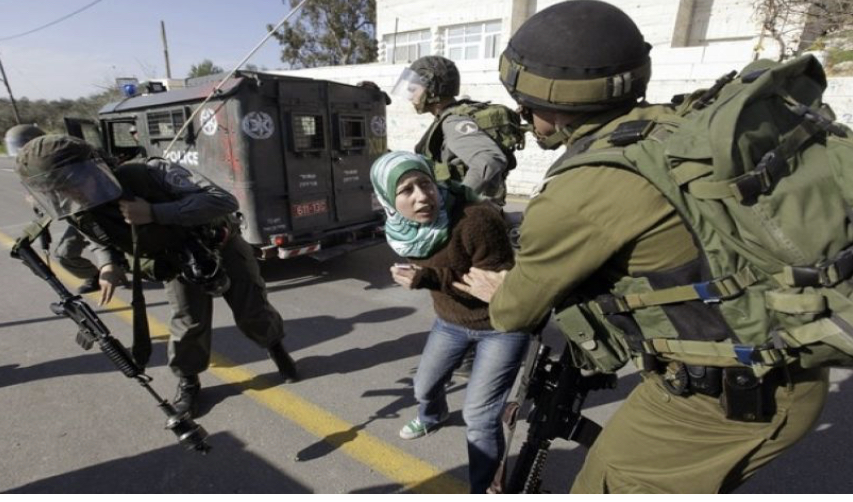
The incident occurred when soldiers from the Israeli occupation police prevented the woman from entering Jerusalem, and took her to a security headquarters, where one of the soldiers harassed her, and his attempts continued for hours without being able to rape her, before another came to rape her after a fight.
Contrary to what many people tend to think, this woman resorted to reporting officially after one of her relatives convinced her to do so, but the Israeli Investigation Unit closed the file more than once “without completing the investigation,” under the pretext that the perpetrator was unknown, while the victim’s lawyer stated that the investigating authorities did not enable him to obtain video recordings from the surveillance cameras located at the police station, nor did it show the victim photos of the police officers who were present during the commission of the crime, to identify the perpetrator.
A look at rape incidents in the archives of the Israeli Military Prosecution.
Since its establishment, the Israeli occupation army has sanctified important values, including: respect for humanity and maintaining the purity of weapons. These values are based on a Jewish heritage that extends back many years.
These words were said by Gadi Eizenkot, Chief of Staff of the Israeli occupation army, in a letter he circulated to recruits in Israel at the end of March 2016, and a response came that was not from an Arab, but from his fellow Israeli, Amir Oren, a senior correspondent and columnist in the Haaretz newspaper. The Israeli army, who was provoked by Eizenkot’s words, especially “the purity of weapons,” considered that his words were a “big mistake,” and pointed to what he described as “a history of corruption and rot that lies behind the legacy of battles.”
Oren devoted an article, dating back to April 3, 2016, in which he refuted Eisenkot’s words, using the archives of the Israeli military prosecution, which included many war crimes that included the liquidation of prisoners and cases of rape, which Israel overlooked, without punishing the perpetrators, as happened with the Palestinian woman. Which was previously talked about.
Oren said: “In most of the operations and crimes, Israel did not release anyone because it simply did not arrest them or try them. Instead of the ‘revolving door’ policy, Israel opened the door through general amnesty laws,” explaining: “When the major wars (1948-1967) ended, feelings of Victory, all those who participated in it were declared heroes, and war crimes were silenced under the slogan “In war we fight, and inside we pardon and forgive.”
Oren cited a number of rape incidents in the files of the Israeli military prosecution, which ended by closing the files without punishing the perpetrators, including rapes that occurred in Acre on the night of May 29, 1948, and another incident in which a Palestinian citizen submitted an invitation in which he said: “Four Israeli soldiers… “They broke into his house, took him out, and raped his wife.” The commander of the city of Ramla ordered an investigation into that incident, but the investigation was also closed.
While another rape crime occurred, in November 1948, at the headquarters of the Israeli 11th Battalion, when four Israeli soldiers met an Arab convoy, which was traveling near the town of Tarshiha, and they stopped two girls, one of whom raped the first, and the rest tried to rape the second, and the soldiers claimed in the investigation “The two girls initially resisted the rape, but then agreed to it and even helped carry out the rape.” This prompted the Public Prosecutor to prosecute the soldiers, but only a few days passed until the general amnesty decision came into effect and the four soldiers were released.
These rape incidents included the rape of young girls who did not exceed the age of 18, including the rape of a 16-year-old girl by soldiers, in front of her parents, in the village of “Iraq Suwaidan,” in November 1948. The military prosecution ordered an investigation into the incident, but the commander of the southern region refused to provide a car for the investigators. The investigation was not conducted in the first place.
Oren narrates another rape incident: “On the day Israel was established, three Israeli military policemen raped a 12-year-old girl in the city of Jaffa. They were tried 10 days after the crime. They were convicted of committing a “disgraceful act” and were sentenced to only three months in prison. But the Chief of Staff ordered that the punishment not be carried out.”
The chief rabbi of the occupation army issued a fatwa permitting the rape of Palestinian women! Israeli soldiers may rape Palestinian and non-Jewish women in the event of war. This is how Eyal Karim, the chief rabbi of the Israeli occupation army, issued a fatwa in a series of exciting fatwas issued by the man, which also permitted the torture of Palestinian detainees to extract confessions, and the killing of injured Palestinians. These fatwas also reinforce what Arwin’s article pointed out about war crimes and rape incidents that have passed. In the end, it went unnoticed, without the perpetrators being punished.
Karim’s statements sparked controversy, and Eisenkot said that they were “incompatible with the values of the Israeli army,” but that did not prevent Karim from retaining his position, after he said in July 2016 that his statements “were limited only to ancient times,” which confirms also, the war crimes committed by the Israeli occupation army in 1948, which Oren mentioned, citing the archives of the Israeli military prosecution.
It seems that officials in Israel are always complaining, at least in the media, about the fact that the Israeli occupation army rapes Palestinian women, which was also evident to a number of Israeli officials, led by Israeli Prime Minister Benjamin Netanyahu, from the Israeli Film Society’s screening of a film called “Libestika” is available in a number of countries around the world, including America and Germany.
What disturbed Netanyahu was the content of the film, which was taken from a true story of two Palestinian girls who were raped in 1994, during the intifada, by a soldier from the Israeli occupation army, to tell of the tragedies they were exposed to, which also included the social “shame” that may befall some Palestinian victims. Therefore, in statements in February 2011, Netanyahu considered showing the film a provocation to him and the Israeli occupation army, demanding that it be stopped.
Testimonies of forced nudity, sexual harassment, and threats of rape. We have several documented and horrific testimonies of Palestinian female prisoners detained in Israeli prisons or freed, all of whom confirm that Israeli interrogators harass the female prisoners and threaten them with rape if they do not make the confessions required of them. This is what Abdel Nasser Farawneh, a researcher specializing in prisoners’ affairs and director of the Statistics Department at the Palestinian Ministry of Prisoners and Ex-Prisoners, says in statements dating back to 2012. In addition to the cases of rape that we reviewed in the report, some Palestinian women freed from captivity narrate the sexual assaults they were subjected to, Forced nudity, sexual harassment, and threats of rape from Israeli occupation soldiers in Israeli prisons.
Among these cases, the liberated prisoner A. H., who said that she was “subjected to two attempted rapes and severe torture, the effects of which remain on her body to this day, despite the passage of many years since her liberation,” while “Sh. A: “The (Israeli) investigator forced me to lift the shawl from my head, played with my hair, and threatened me with rape if I did not confess.” R. spoke. A. about forced nudity and says: “From the moment I was arrested from home, the soldiers conducted a strip search on the ground. Then I was transferred, handcuffed with iron chains, to the Al-Maskobiyya detention center in Jerusalem for investigation, and there I was strip-searched again.”
This is similar to what another prisoner was subjected to. She pointed out that female soldiers harassed her and searched her naked in front of the soldiers. She says: “At the moment of my arrest, there were four female soldiers who brought me in and strip-searched me. One of the soldiers was in the room, and when I refused to take off my clothes in front of him, they beat me severely and stripped me.” I took my clothes off by force, while the soldier looked at me while I was naked.”
She added, crying: “There was a dirty female soldier named Nietzsche who assaulted me and sexually harassed me more than once. She used to come with three female soldiers and take me from my room in the evening under the pretext that they suspected me and wanted to search me. However, she was forcefully sexually assaulting me, and this situation was repeated over and over again, and every time I felt extremely humiliated and cruel, and this situation still continues to this day, whenever I remember it, it makes me feel frustrated and psychologically weak.”
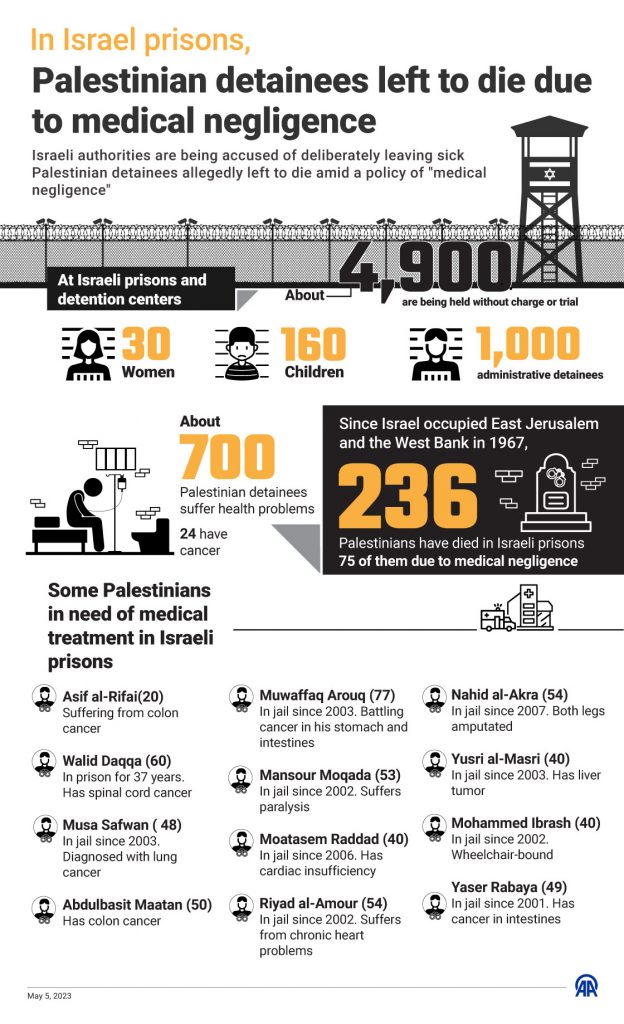
Sexual torture is systematic in the occupation prisons, and 40% of detained children were not spared from it. Israeli authorities engage in systematic sexual torture. Thus concluded an investigation by the Public Committee against Torture in Israel. The investigation was conducted by Daniel Washett, a member of the committee. The investigation came to light in November 2015. It came under the title “Sexual Torture by the Israeli Authorities Against Palestinian Men.” The investigation examined testimonies of sexual assaults in the period from 2012. Until 2015, its executor believed that this investigation was the first of its kind.
The investigation revealed that Palestinian men are also vulnerable to sexual assaults by the occupation forces, not just women. Washit was able to document 60 testimonies about sexual assaults and sexual torture to which Palestinians were subjected, including 77 cases of sexual assault, which varied between verbal sexual harassment (36 cases) and nudity. coercive (35), and physical sexual abuse (6).
In a related context, Palestinian children were also not spared from the sexual assaults carried out by the occupation authorities against Palestinians. In November 2014, the “Palestinian Prisoners Club” group issued a report stating that among the 600 children who were arrested in Jerusalem since June 2014, there were 40% of them were subjected to sexual assault by the occupation forces, which is equivalent to 240 children.
Watch