S. T. Salah, 16/08/26
This audit examines how Israeli political leadership, public opinion, media systems, and electoral competition jointly shaped government policy toward Palestinians from 1948 to 2026. It focuses on the interaction between political rhetoric, voter behaviour, party platforms, and wartime mobilisation across Israel, East Jerusalem, the West Bank, and Gaza.
From the early years of statehood, cabinet debates and Knesset discussions framed Palestinians as a demographic and security threat. Palestinian citizens living under military rule were described by ministers as a “fifth column,” and land expropriation under the Absentees’ Property Law and Land Acquisition Law was justified as necessary for demographic security. Electoral competition centred on Jewish voters, while Arab satellite parties lacked the power to alter land or security policy.
After 1967, electoral incentives shifted toward territorial expansion. Governments annexed East Jerusalem, expropriated land, and authorised settlement blocs without electoral penalty. The 1977 Likud victory normalised settlement as a national project and integrated settlement movements into state planning and funding. Palestinian residents of the occupied territories remained excluded from the elections determining the policies governing their lives.
Explicit transfer rhetoric entered parliamentary politics in 1988 when Rehavam Ze’evi founded the Moledet party advocating removal of Palestinians and later served as a cabinet minister while maintaining this position. Senior officials repeatedly used dehumanising language; Chief of Staff Rafael Eitan said settlement would leave Palestinians “scurrying like cockroaches in a bottle,” and Defence Minister Yitzhak Rabin ordered soldiers to use “force, might and beatings” during the First Intifada.
From the Second Intifada onward, ministers and party leaders increasingly portrayed Palestinians collectively as terrorists and internal enemies. In 2014 Ayelet Shaked amplified calls to treat Palestinian children as enemies, and Naftali Bennett publicly stated he had “killed many Arabs.” During the May 2021 unrest, ministers framed violence in mixed cities as Arab rioting while Jewish mob attacks went largely uncondemned.
Electoral incentives reinforced these narratives. Governments campaigning on stronger military force and expanded settlement policies were repeatedly returned to power. Major Gaza wars and intensified settlement building occurred without electoral punishment and often strengthened incumbent governments’ political standing.
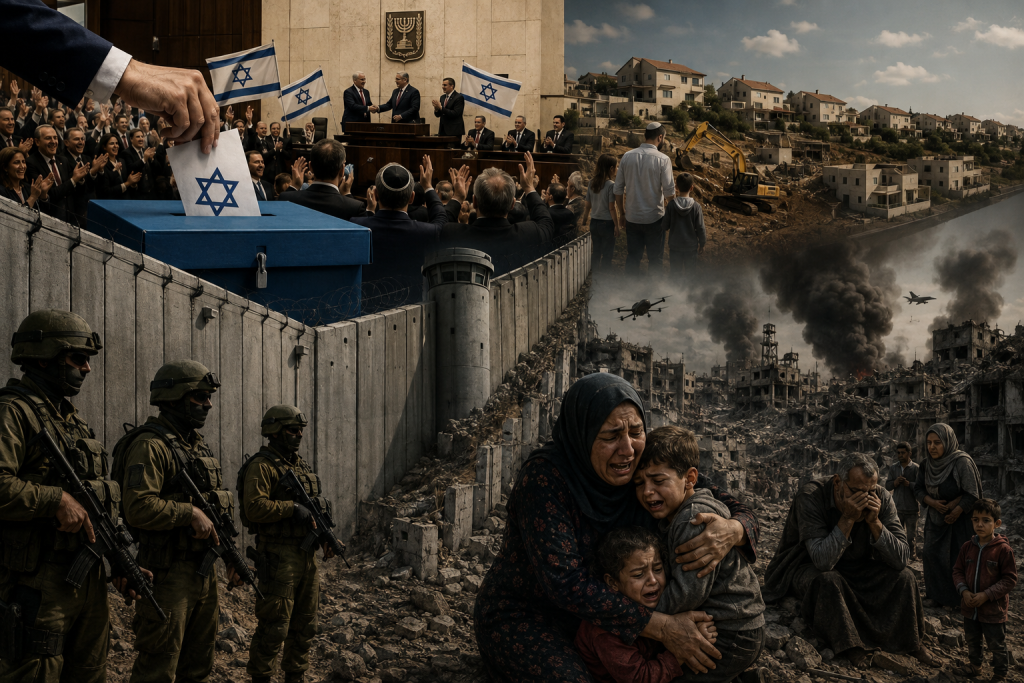
The 2022 election marked consolidation of annexationist and supremacist platforms. Coalition agreements committed to expanding settlements and extending Israeli sovereignty over parts of the West Bank, while ministers from far-right parties gained authority over policing, finance, and West Bank administration.
Public opinion repeatedly aligned with political leadership. Surveys across decades recorded support for segregation, transfer proposals, and reduced rights for Palestinian citizens. A 2016 Pew survey found nearly half of Jewish Israelis supported expulsion of Arabs and large majorities supported preferential treatment for Jews. During Gaza wars, polling showed strong support for bombardment and opposition to humanitarian aid.
Legal enforcement remained asymmetric. Palestinian politicians and activists faced prosecution for speech offences, while racist or genocidal rhetoric by Jewish officials rarely produced legal consequences. Polling by the Israel Democracy Institute and the Haifa University Index of Arab–Jewish Relations recorded majority support for segregation, opposition to Arab parties joining governing coalitions, and backing for loyalty-based citizenship measures. After October 2023, multiple polls reported majority opposition to humanitarian aid entering Gaza and strong support for continued military operations despite starvation and genocide.
Economic incentives reinforced electoral outcomes. Settlements offered subsidised housing and infrastructure, while the occupation economy generated employment and investment in construction, technology, and security sectors. Parties promising expansion benefited from these constituencies.
The record shows that political rhetoric, public opinion, and electoral competition operated as a single system that repeatedly rewarded policies of territorial expansion, military control, and denial of Palestinian political self-determination across decades.