Recent Posts
Recent Comments
Archives
- October 2026
- September 2026
- August 2026
- July 2026
- June 2026
- May 2026
- April 2026
- March 2026
- February 2026
- January 2026
- December 2025
- November 2025
- October 2025
- September 2025
- August 2025
- July 2025
- June 2025
- May 2025
- April 2025
- March 2025
- February 2025
- January 2025
- December 2024
- November 2024
- October 2024
- September 2024
- July 2024
- June 2024
- May 2024
- March 2024
- February 2024
- January 2024
- December 2023
- October 2023
- September 2023
Categories
- Admin
- Alina-Palestina
- American Congressmen Terrorists
- Amnesty International
- Assaf
- Astromystic
- Banksy
- Barghouthi
- Basel Adra
- BBC
- BDS
- Blindboy podcast
- Caitlin Johnstone
- Celebrities
- Cenk Uygur
- Chris Hedges
- Comedy
- Couple Sculptures
- Disabled People in Palestine
- Dr Husam Abu Safia
- Dr. Bassem Youssef
- Edward Said
- Epstein
- Evidence of Israeli Fascism and Nazism and Genocide
- Francesca Albanese
- Gaza
- Gaza Journalists
- Gazaleh
- Greta Thunberg
- Hamadeh
- Heba Al Agha
- Hilmi
- Hind Rajab
- Hossam Shabat
- Illegal Israeli settlements in Palestine
- In Handala’s Playground
- Ireland
- Iyah May
- Jeremy Corbyn
- Justice
- Karim Khan
- Katie Halper
- Letters to the Olive Tree
- Lowkey
- Macklemore
- Mahmoud Darwish
- Malak Matar
- Malik Qraiqea
- Massacres & genocides
- Matthew Arndt
- Max Blumenthal
- Media
- Mehdi Hassan
- Middle East
- Miriam Margolyes
- Mohammed El Kurd
- Moist Critical Penguinz0
- Mustafa Barghouthi
- Naji Al Ali
- News from the apartheid
- Nobel Gaza Donkey ‘NGD’
- Norman Finkelstein
- Osama Hajjaj
- Osama Nazzal
- Owen Jones
- Palestinian agriculture
- Palestinian art & culture
- Palestinian cities, towns, villages and camps
- Palestinian creativity
- Palestinian cuisine
- Palestinian dabke
- Palestinian diaspora
- Palestinian history
- Palestinian Hostages in Israeli torture centres
- Palestinian prisoners
- Palestinian Prisoners
- Palestinian Resilience Day
- Palestinian Women
- Peace
- Phalapoem editor
- Philip Giraldi
- Piers Morgan
- Poems
- Politics
- Ralph Nader
- Roger Waters
- S. T. Salah
- Sami Yusuf
- Sammy Obeid
- Sing for Palestine
- Sliman Mansour
- Smirat’s Column
- Songs
- South Africa
- Starvation war
- Susan Abullhawa
- UK
- Uncategorized
- UNRWA
- USA
- Videos
- Voice of Palestine
- Wael Al Dahdouh
A Palestinian Girl from Gaza Addresses Trump
Posted in Evidence of Israeli Fascism and Nazism and Genocide, Media, Videos
Tagged Gaza genocide
Comments Off on A Palestinian Girl from Gaza Addresses Trump
“How did a you find Gaza?”
Posted in Evidence of Israeli Fascism and Nazism and Genocide, Media, Videos
Tagged Gaza genocide
Comments Off on “How did a you find Gaza?”
Lives of Palestinian children matter.
Posted in Evidence of Israeli Fascism and Nazism and Genocide, Gaza, Massacres & genocides, Media, Videos
Tagged Gaza genocide, Palestinian children
Comments Off on Lives of Palestinian children matter.
Israeli War on Gaza Doctors, Medical Staff and Hospitals
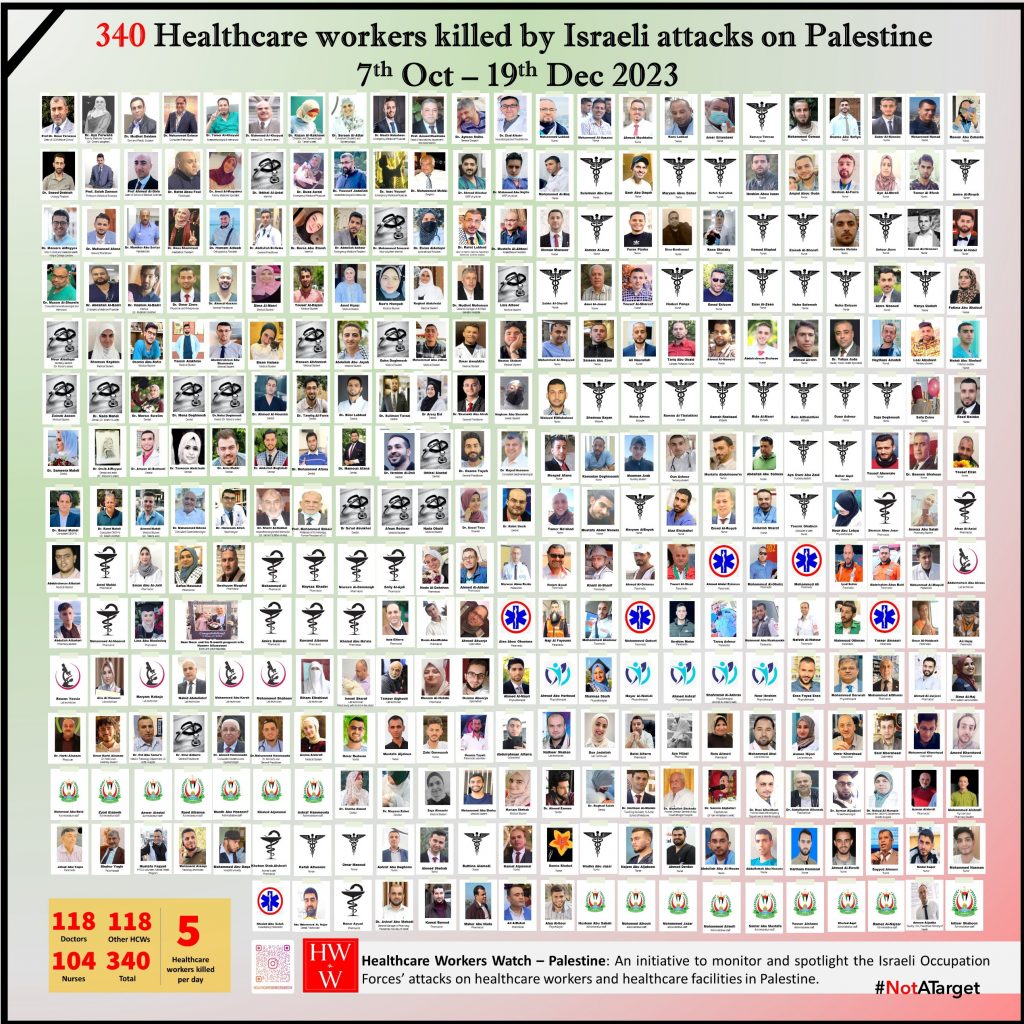
Background:
Israeli massacre of medical personnel in Gaza: since October 7th the Israeli army killed 685 medical doctors, Nurses and health workers and injured 900 of them . It bombarded and destroyed 104 ambulances, 142 health institutions, 23 hospitals and 53 primary health care centers. Is this still self-defence?


Healers, custodians of life's grace,
Six hundred eighty five tales erased.
Nurses and doctors, casualties of strife,
In chaos' canvas, they gave their life.

Ambulances, once swift in urgent plea,
A hundred and four, now silenced debris.
Institutions crumbled, a hundred forty-two,
Hospitals shattered, twenty-three bid adieu.

Primary centers lost, fifty-three in the dark,
Gaza's heartbeat falters, leaves its mark.
A tapestry of tragedy, a solemn arc,
A symphony of loss, a haunting embark.
Posted in Gaza, Massacres & genocides, News from the apartheid, Palestinian history, Poems
Tagged Gaza doctors
Comments Off on Israeli War on Gaza Doctors, Medical Staff and Hospitals
Update on Gaza genocide
The most important statistics of the genocidal war waged by the “Israeli” occupation on the Gaza Strip for day 160 – Thursday, March 14, 2024
▪️ (160) days since the genocidal war.
▪️ (2,761) massacres committed by the occupation army.
▪️ (38,341) martyrs and missing persons.
▪️ (31,341) martyrs who arrived in hospitals.
▪️ (13,790) child martyrs.
▪️ (27) children were martyred as a result of famine.
▪️ (9,100) female martyrs.
▪️ (364) martyrs from medical teams.
▪️ (48) Civil Defense martyrs.
▪️ (133) martyred journalists.
▪️ (7,000) missing.
▪️ (73,134) infected.
▪️ (72%) of the victims are children and women.
▪️ (17,000) children live without their parents or one of them.
▪️ (11,000) wounded people need to travel for “life-saving and dangerous” treatment.
▪️ (10,000) cancer patients face the risk of death.
▪️ (700,000) infected with infectious diseases as a result of displacement.
▪️ (8,000) cases of viral hepatitis infection due to displacement.
▪️ (60,000) pregnant women are at risk due to lack of health care.
▪️ (350,000) chronic patients are at risk due to non-administration of medications.
▪️ (269) cases of arrest of health personnel.
▪️ (10) cases of arrest of journalists whose names are known.
▪️ (2) million displaced people in the Gaza Strip.
▪️ (166) government headquarters destroyed by the occupation.
▪️ (100) schools and universities were completely destroyed by the occupation.
▪️ (305) schools and universities partially destroyed by the occupation.
▪️ (223) Mosques completely destroyed by the occupation.
▪️ (289) mosques partially destroyed by the occupation.
▪️ (3) Churches targeted and destroyed by the occupation.
▪️ (70,000) housing units were completely destroyed by the occupation.
▪️ (290,000) housing units that were partially destroyed by the occupation and uninhabitable.
▪️ (70,000) tons of explosives dropped by the occupation on Gaza.
▪️ (32) hospitals that were taken out of service by the occupation.
▪️ (53) health centers that the occupation put out of service.
▪️ (155) health institutions targeted by the occupation.
▪️ (126) ambulances were targeted by the occupation army.
▪️ (200) archaeological and heritage sites destroyed by the occupation.
European commissioner calls for pressure on Israel to allow more aid into Gaza
International community needs to take action to protect civilians from hunger and violence in Gaza, says Elisa Ferreira
Melike Pala |14.03.2024 – Update : 14.03.2024
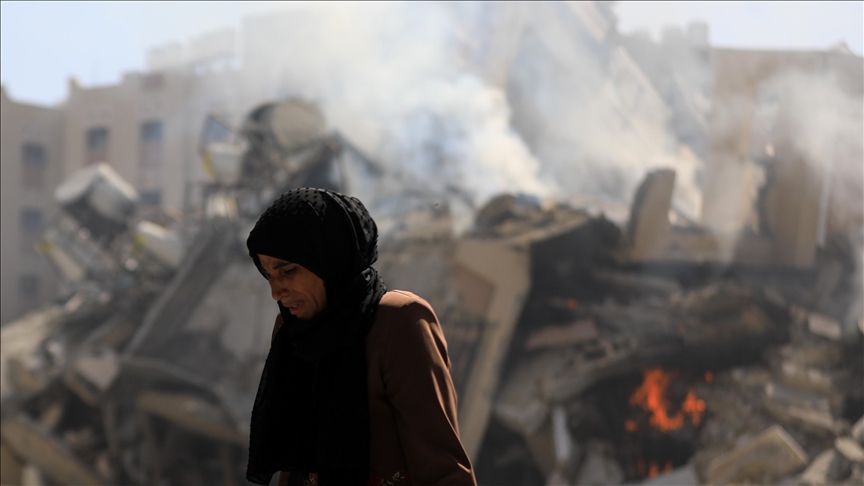
ANKARA/BRUSSELS
The European commissioner for cohesion and reforms called Wednesdayi for pressure on Israel to allow the flow of more humanitarian aid into the Gaza Strip.
The tragic events in Gaza underscore the urgency of ending the war, increasing humanitarian aid and releasing the hostages, Elisa Ferreira told a session of the European Parliament on the immediate risk of mass starvation in Gaza and attacks on humanitarian aid deliveries.
Reminding that civilians are dying from starvation in the besieged enclave, where the health system has collapsed, Ferreira also expressed concern over a planned Israeli military operation in the southern Gaza city of Rafah, which is packed with 1.5 million displaced Palestinians.
Anyone concerned about the situation in Gaza should pressure the Israeli government to allow unimpeded land access for aid trucks, she added.
Saying that the international community needs to take action to protect civilians from hunger and violence, she stressed that the European Union will continue to work with the UN agency for Palestinian refugees (UNRWA).
Several countries suspended funding to UNRWA last month following Israeli accusations that 12 of the agency’s thousands of employees took part in the Oct. 7 attack last year by the Palestinian group Hamas on Israel.
The EU and Canada, which had suspended funding, announced later that they would resume support.
‘Hunger as a weapon’
Some EU lawmakers pointed out that the famine in the Gaza Strip is a result of Israel’s actions which constitute “genocide” and said those who remain silent are “complicit” in this.
This crisis was created entirely by Israel’s actions and the inaction of the world, which remained silent to the plight of Gazans, said Irish member of the European Parliament (MEP) Grace O’Sullivan.
Belgian MEP Hilde Vautmans also reminded that children are dying of hunger in Gaza and that humanitarian aid convoys and civilian infrastructure can never be the target of war.
Hunger can never be used as a weapon, she noted, stressing that Israel must open all corridors so that aid can reach the Gaza Strip.
Spanish lawmaker Miguel Urban Crespo said what is happening in the besieged Palestinian enclave is a “genocide.”
Saying that the world is watching a genocide take place in the middle of the 21st century, he noted that Israel not only kills people with bombs but also with hunger.
Israel has imposed a crippling blockade on Gaza since Oct. 7, leaving its population, particularly residents of northern Gaza, on the verge of starvation.
Israel has waged a deadly military offensive on the Gaza Strip since an Oct. 7 cross-border attack by the Palestinian group Hamas in which 1,163 people were killed.
More than 31,000 Palestinians, mostly women and children, have since been killed in Gaza and over 73,000 injured amid mass destruction and shortages of necessities.
The Israeli war has pushed 85% of Gaza’s population into internal displacement amid a crippling blockade of most food, clean water and medicine, while 60% of the enclave’s infrastructure has been damaged or destroyed, according to the UN.
Israel is accused of genocide at the International Court of Justice. An interim ruling in January ordered Tel Aviv to stop genocidal acts and take measures to guarantee that humanitarian assistance is provided to civilians in Gaza
Artists for Palestine UK
Phalapoem editor, 26/02/25
800+ programme-makers condemn censorship and racism after BBC pulls Gaza documentary
February 26, 2025
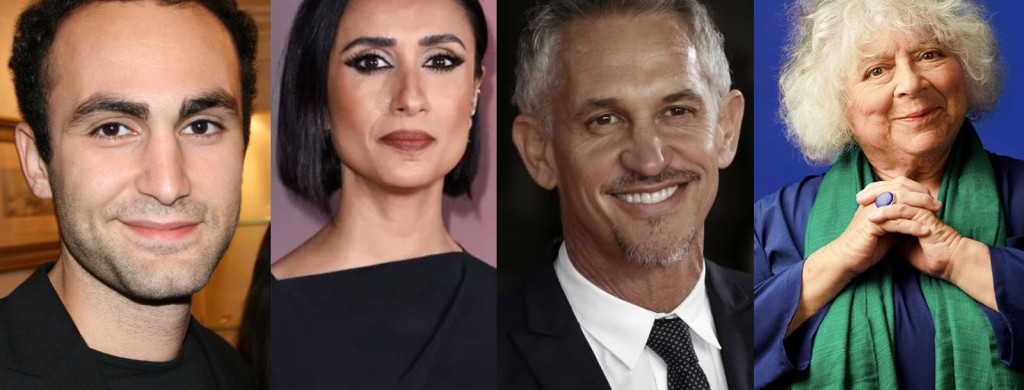
Gary Lineker, Khalid Abdalla, Anita Rani, and Miriam Margolyes have joined over 800 film, TV, and media workers in condemning censorship and racism after the BBC pulled a documentary about children’s lives in Gaza.
The media professionals, including twelve BBC staff, sent a letter to the broadcaster’s director-general Tim Davie, chair of the board Samir Shah, chief content officer Charlotte Moore, and head of news and current affairs Deborah Turness on Wednesday. The letter (in full below) condemned a “racist” and “dehumanising” campaign targeting the film Gaza: How to Survive a War Zone, which the BBC removed from its iPlayer streaming service after pressure from supporters of Israel. The BBC’s board is set to discuss the documentary on Thursday.
“Beneath this political football are children who are in the most dire circumstances of their young lives. This is what must remain at the heart of this discussion,” the letter read. “As programme-makers, we are extremely alarmed by the intervention of partisan political actors on this issue, and what this means for the future of broadcasting in this country.”
The letter signatories include journalists Zoe Williams and Gary Younge, senior executives & filmmakers Brian Hill and Rich Peppiatt, and Sarah Agha, who presented the BBC documentary series The Holy Land And Us: Our Untold Stories. The letter said Gaza: How to Survive a War Zone offers an “all-too-rare perspective on the lived experiences of Palestinian children” and “deserves recognition” rather than censorship.
“The UK film and TV industry will no longer be intimidated by those whose sole mission it is to censor the voices of the many who are defending the rights of children, the marginalised and those in desperate need. All stories have the right to be told and journalistic scrutiny should not be at the whim of those who deem certain lives unequal,” said letter signatory Nada Issa, an award-winning producer/director and journalist who is part Palestinian and Lebanese.
The BBC has said the documentary would not be available on iPlayer while additional “due diligence” checks take place. Sources at the broadcaster have reportedly said the intention was to eventually make the film available to viewers once more.
The letter urged the BBC to reject efforts to have the film permanently removed or “subjected to undue disavowals”, saying that surrendering to efforts to stop its return to iPlayer would indicate “racialised smears against Palestinians outweigh journalistic ethics and public interest”.
The signatories also warned against intrusive scrutiny of Abdullah Al-Yazouri, a 14-year-old child who narrated Gaza: How to Survive a War Zone. His father, Dr Ayman Al-Yazouri, served as Gaza’s deputy agriculture minister – a civil service role concerned with food production.
“ Almost half of Gaza’s population are children. What they have experienced over the past 17 months is something no child deserves to ever go through,” said Liam O’Hare, an award-winning documentary producer/director who signed the letter. “As journalists and filmmakers we have a duty to help tell their story and that’s what this film did so brilliantly. The BBC cannot allow a politicised campaign to succeed in silencing the children of Gaza.”
Posted in BBC, Gaza, Palestinian art & culture, Palestinian history, UK
Tagged Apartheid, Bbc, Gaza genocide, Gaza war, israel’s apartheid, israeli occupation, justice
Comments Off on Artists for Palestine UK
In Handala’s Playground: Season 1, Episode 8 : Amal’s Unfinished Lullaby
S.T. Salah, 12/02/2025
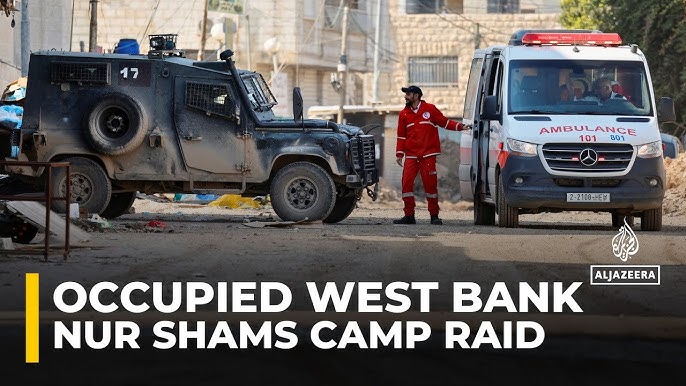
(The night is heavy with smoke and sorrow. The Nur Shams refugee camp is in ruins—walls shattered, streets littered with rubble. Handala, the eternal 10-year-old with his back turned to the world, stands at the edge of the destruction. His small, bare feet are planted in the blood-streaked dirt. Beneath the dim flicker of a burning home, he watches over Sondos Shalabi, who lies on the cold ground, her hands cradling her belly—her unborn child no longer moving inside her.)
Sondos: (weakly, her voice barely above a whisper) Handala… you’ve been here all this time, haven’t you? Watching… waiting…
Handala: (his voice is quiet, but firm) I have never left. Not when they bulldozed homes in Jenin. Not when they filled the night with gunfire in Tulkarem. Not when they called our cries for freedom “terror.” I have always been here.
Sondos: Then you saw it? You saw how they opened fire on our car? How they didn’t even hesitate? My husband… he tried to shield me, but their bullets were precise. They always are. They don’t miss when it comes to us.
Handala: (nods, his fists clenched at his sides) They aim for the heart. The home. The future. They saw a mother carrying her child and decided she was a threat.
Sondos: (a tear slips down her cheek, mixing with the dust of her face) My baby… she was almost here, Handala. I had a name for her. Do you want to hear it?
Handala: (softly) Yes.
Sondos: Amal. It means “hope.” I thought maybe—maybe despite everything—she would know a Palestine with fewer ruins. Fewer funerals. Maybe she would hear laughter before gunfire. Maybe she would grow up and never have to see you.
Handala: (a deep silence hangs between them) She would have loved the olive trees. She would have danced in the streets of Nablus and hummed songs from her grandmother’s lips. But they knew her name, Sondos. Even before she was born. They always know our names before they erase them.
Sondos: (her breath is shallow, her fingers trembling against her stomach) They wouldn’t even let me fight for her, Handala. The doctors, the ambulances—they were kept away. Do you know what it feels like to know help is just down the road, but the soldiers won’t let them reach you? That my baby could have lived, but they chose for her to die?
Handala: I know. I have seen mothers scream at checkpoints, holding their bleeding children. I have seen fathers forced to kneel beside their sons’ bodies, unable to close their eyes. I have seen homes turned to ashes before the tea on the stove has time to go cold.
Sondos: (her eyes flutter shut, exhaustion taking hold) Will you remember her, Handala? Will you carry her name?
Handala: I will. I will whisper it in the ears of the wind. I will carve it into the stones of Jerusalem. I will press it into the soil of every grave they have made. And when Palestine is free, Amal’s name will be among the first to be sung.
(The sound of distant gunfire cuts through the night. Sondos’ body stills. The silence that follows is the kind that only war understands. Handala does not cry. He does not turn. He only stands, as he always has, bearing witness to another stolen life. He is a child who will never grow old, living in a land where children do not get the chance to.)
Posted in In Handala’s Playground, Massacres & genocides, News from the apartheid, Palestinian art & culture, Palestinian history, Phalapoem editor
Tagged genocide, Handala, israel’s apartheid, israeli occupation, Palestine, West Bank
Comments Off on In Handala’s Playground: Season 1, Episode 8 : Amal’s Unfinished Lullaby
Raping Prisoners in Israeli Apartheid is not a Crime
Posted in Evidence of Israeli Fascism and Nazism and Genocide, News from the apartheid, Videos
Tagged Apartheid, Gaza genocide, genocide, israeli occupation
Comments Off on Raping Prisoners in Israeli Apartheid is not a Crime
Ramadan in Gaza: ‘We used to adorn our street, now everything around us is bleak’
Displaced families prepare to spend holy month in Rafah amid food shortages and fear of attack
Aseel Mousa in Gaza and Jason Burke in Jerusalem
Sun 10 Mar 2024
Seventy days after they were forced to leave their house in the southern Gaza city of Khan Younis, Hanaa al-Masry, her husband and their six children are preparing for Ramadan in their new home: a dilapidated tent. Here, there will be no decorations, no joyous family meals and no reading of the Qur’an under the lemon and orange trees in the garden.
The Muslim holy month – a time for friends and family as well as religious contemplation, prayer and fasting – starts on Monday and will be like none that anyone in Gaza can remember.
The Masry family fled Khan Younis after receiving leaflets from the Israeli military telling them to relocate for their own safety. They made their way to the city of Rafah on the border with Egypt and now live in a crowded makeshift camp, sleeping and eating amid a jumble of salvaged possessions.
“My daughters used to carefully save their money to buy decorations and every year I would chose a new Ramadan lantern,” Hanaa al-Masry, 37, said. “It is very depressing, very difficult.”
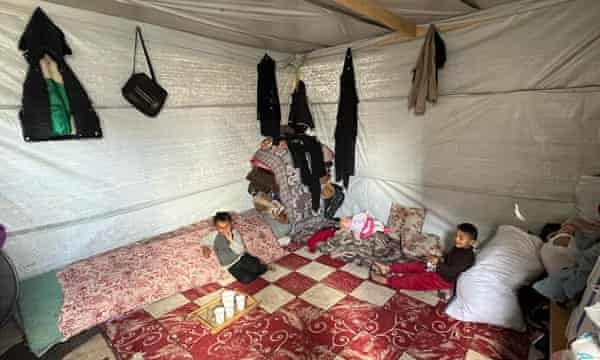
The Masry family’s tent in Rafah. Photograph: Aseel Mousa
This year, there will be no lanterns. Masry will prepare neither suhoor, the meal taken before the start of the ritual day-long fast, nor iftar at its end.
It saddens her: “I used to love preparing a meal of cheese, jam, beans and eggs to sustain my family throughout the fast and then something tasty for iftar.”
Conditions in Rafah are better than in the north of territory, where local health officials say 20 deaths by starvation have been recorded, but basics are still in short supply. Many are surviving on flatbread cooked over wood fires or basic gas hobs, and tinned goods trucked in by humanitarian agencies from Egypt. Half a kilo of sugar now costs $10 and salt is almost unobtainable. Fresh fruit or vegetables are rare and very expensive.
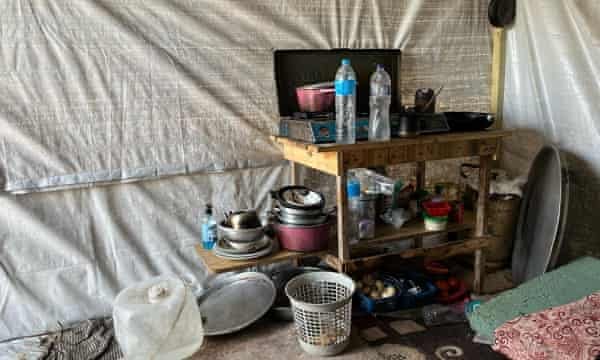
The family’s makeshift kitchen. Photograph: Aseel Mousa
“I am not the only one yearning to uphold our customs. My neighbours and I used to adorn our street with lights and lanterns, but now everything around us is bleak. The streets bear the scars of Israeli bombings, and the community is in mourning,” said al-Masry.
The war was triggered in October when Hamas militants attacked southern Israel, killing 1,200 people, mainly civilians, and abducting 250 more, of whom about half were freed in a short-lived truce in November.
More than 31,000 people in Gaza have been killed in the Israeli offensive launched after the Hamas attack, most of them women and children, according to officials in the territory. Much of it has been reduced to rubble.
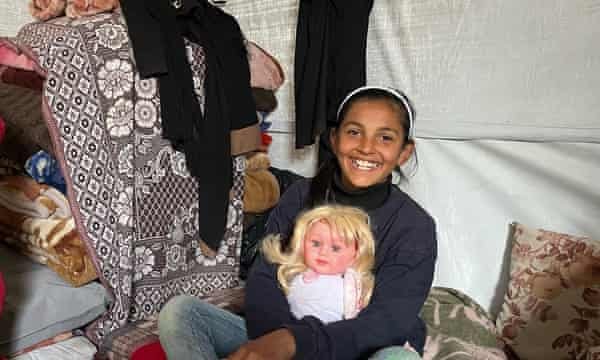
Hanaa al-Masry’s daughter Lamar in their tent as the family prepare for Ramadan. Photograph: Aseel Mousa
Israel blames Hamas for the high civilian death toll, saying the militant organisation, which has run Gaza since 2007, uses civilians as human shields. Hamas denies the charge.
Hussein al-Awda, 37, arrived in Rafah more than a month ago after spending much of the war in a UN-run shelter near Khan Younis. A programme officer with an international NGO, he has barely eaten meat since the conflict began, and recently has been surviving on tinned beans.
“There are some nuts and dried fruits in the market, the sort of thing we would have to break our fast in Ramadan, but they are just so expensive. Iftar will just be more beans,” Awda said.
Electricity was cut off by Israel at the beginning of the conflict, most of the sanitation and power infrastructure has been destroyed and the minimal amounts of fuel allowed into the territory are insufficient for running pumps or generators. Everywhere, donkey carts have replaced cars as the principal mode of transport.
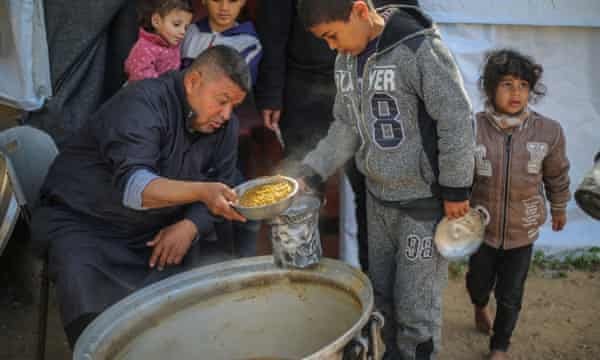
Children queuing for food in Rafah on Sunday. Photograph: Ahmad Hasaballah/Getty Images
Awda, whose house in Gaza City was destroyed in the first weeks of the war, spent all his savings on getting his wife and three young children to Cairo last month. He stayed to look after his elderly and unwell parents, who are too frail to travel.
“We’ve always been together for Ramadan. To be split up like this … I don’t know how to explain it to my children. My youngest is beginning to talk and I can only hear him on my phone if I can find some internet connection but even that is very hard,” he said.
Alaa al-Shurafa, a lecturer at the Islamic University, was told by the Israeli military to flee her home in Gaza City five months ago. Since then she has been living with her parents in a small room in an abandoned apartment block in Rafah.
Her family are scattered. One sister is in Gaza City, another is elsewhere in Rafah. “We are now isolated from our loved ones, uncertain of when we can return to our home in Gaza,” Shurafa said.
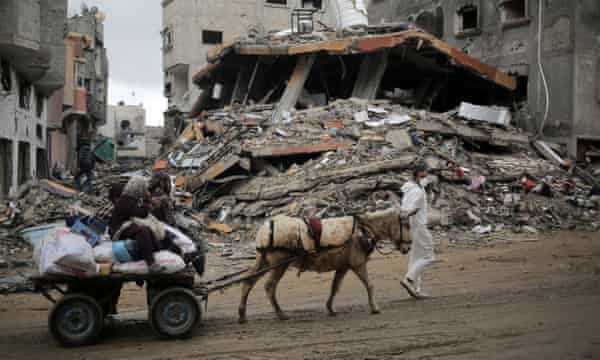
Palestinians transport their belongings on a donkey-pulled cart as they flee Khan Younis. Photograph: AFP/Getty Images
Looming over all those trying to celebrate Ramadan in Rafah is the prospect of an imminent attack. Israeli officials say Hamas leaders are based in the city along with four battalions of militants – the only major remaining fighting force of the Islamist organisation.
Though Benjamin Netanyahu, Israel’s prime minister, pledged last week to continue to seek “total victory”, he is under intense international pressure to halt Israel’s military operations and allow more humanitarian aid into Gaza.
The prospect of a military assault in a city home to more than a million displaced people that is also a major logistics hub for aid operations has raised deep concerns. “We are just sitting here waiting for our fate … The hardest thing is we have no idea how long it will be like this,” said Awda.
Masry remembers watering the trees and roses in her garden in Khan Younis daily after the dawn prayer. “I used to find solace in sitting in my garden, reciting the Qur’an and offering prayers to God. Now, my garden lies in ruins.”
Posted in Gaza, Palestinian art & culture
Tagged Ramadan in Gaza
Comments Off on Ramadan in Gaza: ‘We used to adorn our street, now everything around us is bleak’
AIPAC’s Antisemitism: Suppressing Truth, Enabling Holocaust
Ralph Nader, 28/02/25
AIPAC, the domestic lobby for the Israeli-Government-Can-Do-No-Wrong, has corrupted the Congress and contributes to widespread censorship against Americans’ freedom of speech on U.S. policy and Palestinian rights.
Their loyalty to the genocidal Netanyahu has no bounds. Example—they refused to support the entry of American journalists (and even Israeli journalists), barred for years by the Israeli government to enter Gaza to inform the American people and taxpayers about what is going on in that devastated enclave. AIPAC even refuses to support the entry into the U.S. of horribly burned and amputated Palestinian youngsters for treatment by ready and able hospitals.
AIPAC’s antisemitism against Palestinian Arab semites is brutally violent and is contributing to the Palestinian Holocaust by blocking any efforts in Congress or in the Executive Branch to condition the export of weapons to Netanyahu, thereby violating six federal U.S. statutes.
No wonder an increasing number of legal experts believe that AIPAC should register as a Foreign Agent under the Foreign Agents Registration Act.
Posted in Gaza, Massacres & genocides, Ralph Nader
Tagged AIPAC, Apartheid, Gaza genocide, Gaza war, genocide, israel’s apartheid, israeli occupation
Comments Off on AIPAC’s Antisemitism: Suppressing Truth, Enabling Holocaust