S.T. Salah, 21/11/26
On 19 November 2026, the International Court of Justice (ICJ) delivered a historic judgment that will resonate far beyond the borders of Myanmar. In a landmark decision, the world’s highest court found that Myanmar had committed genocide against the Rohingya population during its military operations in northern Rakhine State in 2017. For the first time in its history, the Court formally found a state responsible for committing genocide.
For the Rohingya, this was a moment of long-awaited recognition. For hundreds of thousands of survivors who were driven from their homes, witnessed the destruction of their communities, endured sexual violence and lost family members, the judgment represents something that years of political statements and international expressions of concern could never deliver: an authoritative judicial recognition of what was done to them.
Yet the significance of this judgment extends well beyond Myanmar. Its implications reach directly into the ongoing legal implications of the Israeli genocide in Gaza, and the responsibilities of the international community.
The message from The Hague is difficult to ignore.
The Court examined the killings, serious physical and psychological harm, sexual violence, the destruction of homes and the systematic persecution of the Rohingya. It rejected the argument that the military operation could simply be explained as a security or counterinsurgency campaign. Having considered the totality of the evidence, the judges concluded that genocidal intent was the only reasonable inference.
This is an important legal distinction. A government cannot automatically escape responsibility for genocide by describing its military operations as counterterrorism, national security or the pursuit of legitimate military objectives. Security concerns do not provide a licence to destroy a civilian population, nor do they remove a state’s obligations under international law.
The judgment also carries an important message about the relationship between a state’s actions and its responsibility to prevent genocide. Myanmar was found not only responsible for committing genocide but also in breach of its obligations to prevent genocide and punish those responsible. The Court further addressed the failure to enact adequate legislation and the destruction of evidence.
These findings matter enormously when considering Gaza genocide.
South Africa’s case against Israel before the same Court concerns alleged violations of the 1948 Genocide Convention during Israel’s genocide in Gaza. The ICJ has already issued provisional measures requiring Israel to take steps to prevent genocide by the Convention, preserve evidence and facilitate humanitarian assistance. However, the provisional measures proceedings must not be confused with a final judgment on whether genocide has occurred. That question remains to be determined.
Nevertheless, the Myanmar judgment provides an important legal framework against which the arguments in the Gaza genocide will inevitably be examined.
One of its most significant implications concerns the assessment of genocidal intent. The Court demonstrated that intent does not have to be established through an explicit written order or a single declaration by a political or military leader. It can be established through the cumulative examination of conduct, patterns of violence, the circumstances surrounding the acts and the broader context in which they occur.
This is particularly relevant when examining the destruction of civilian infrastructure, mass displacement, deprivation of essential resources, starvation, the killing and serious injury of civilians and statements made by officials. No single element automatically establishes genocide. The evidence must be examined collectively and against the demanding legal threshold. But neither can such evidence simply be dismissed by invoking military necessity.
There is another uncomfortable question for Israel’s international partners.
The Genocide Convention does not merely prohibit states from committing genocide. Article I obliges its signatories to prevent and punish it. This obligation does not begin only when a court has delivered a final judgment. Under the principles established by the ICJ, states must act when they know, or should normally have known, of a serious risk that genocide may be committed. Their responsibility is one of due diligence, requiring them to use the means reasonably available to them to prevent the crime.
This fundamentally challenges the selective approach to international law that has characterised much of the international response to Gaza genocide.
Governments cannot celebrate the judgment against Myanmar, praise international justice and demand accountability for the Rohingya while treating their obligations differently when the allegations concern an important political or military ally.
The question is not whether Israel should be treated differently because of its security concerns, its historical suffering or its strategic relationships. The question is whether the same legal standards apply to every state.
If they do, those standards must also apply to Israel.
The United States, the United Kingdom, Germany and other governments that maintain close military, diplomatic and economic relationships with Israel must consider the consequences of their own policies. Arms transfers, military cooperation, diplomatic protection and the use of political influence are not detached from the obligations imposed by international law. Each government must assess the available evidence, the risk of genocide and the measures it is legally required to take.
Complicity in genocide has its own legal requirements, and responsibility must be established on the evidence. But the obligation to prevent genocide is a separate responsibility. A government cannot simply wait for a final judgment before considering whether it should take preventive action.
That is where the political embarrassment for the hypocritical governments becomes particularly significant.
For years, many Western governments have presented themselves as defenders of the international rules-based order. They have invoked human rights, international humanitarian law and accountability when condemning atrocities committed by governments they oppose. Yet their response to Gaza genocide has exposed serious questions about whether these principles are being applied consistently.
Condemnations without meaningful preventive action risk becoming little more than diplomatic performances. Statements expressing concern cannot substitute for the legal obligations of states. Nor can the language of peace and humanitarian concern indefinitely coexist with policies that fail to address a serious risk of mass atrocities.
The Rohingya judgment makes this contradiction harder to ignore.
There is also a lesson for the United Nations and the wider international community. The ICJ can establish legal responsibility, issue binding judgments and clarify the obligations of states. But it does not possess an independent enforcement mechanism capable of compelling governments to comply. Political will, international cooperation and the willingness of states to implement judicial decisions remain essential.
Myanmar must now comply with the Court’s judgment, investigate and punish those responsible, provide reparations and facilitate the safe, voluntary and dignified return of Rohingya refugees. For the estimated 1.2 million Rohingya refugees living in Bangladesh, however, a judicial victory does not immediately restore their homes, security, citizenship or dignity.
Justice must become something people can experience in their lives, not simply something recorded in legal documents.
The same principle applies to Gaza genocide. A future judgment, whatever its findings, will mean little to families who have lost their homes, children who have lost their parents and survivors who have been left without the basic conditions necessary for human existence unless the international community is prepared to translate legal principles into action.
Ultimately, the significance of the Rohingya ruling is that it demonstrates that the Genocide Convention is capable of holding a state accountable, even when that state invokes security and military necessity to defend its actions.
It also places a question before every government that has signed the Convention:
Will you defend international law when it is politically convenient, or will you defend it when doing so carries a political and economic cost?
The Rohingya waited years for the international legal system to recognise their suffering. Their recognition should not become another isolated moment of international sympathy, followed by silence and inaction elsewhere.
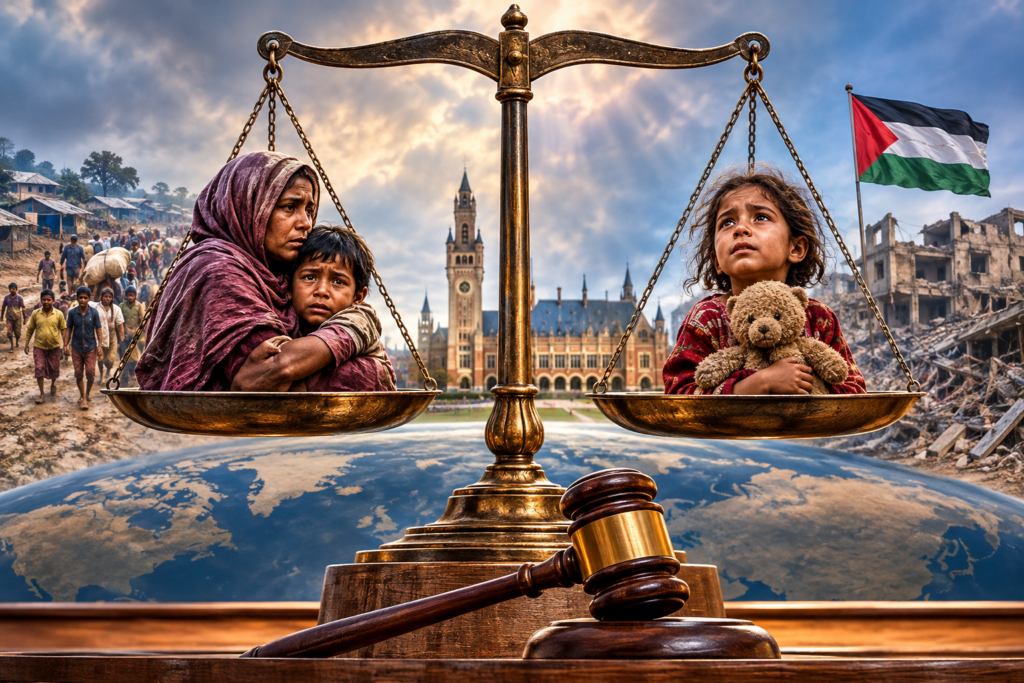
A Palestinian child in Gaza is entitled to the same protection under international law as a Rohingya child in Myanmar. A civilian’s life does not acquire greater or lesser value according to the nationality of the person responsible for their suffering.
There must be no hierarchy of victims, no hierarchy of human rights and no hierarchy of accountability.
If international law is universal, its application must be universal too. Otherwise, the world is not defending a rules-based international order. It is defending a system in which the powerful determine when the rules matter and when they can be ignored.
The Rohingya judgment is a historic moment for justice. Its real legacy will be measured not only by what it means for Myanmar, but by whether the international community has the courage to apply the same principles to Gaza and everywhere else civilians face the threat of mass atrocities.
The world has heard the Court’s judgment. The question now is whether those with the power to act are prepared to listen.