
The Cowardice of Governments Facing Gaza and the Price of Political Careers, Economic Power and American Bullying
S.T. Salah, 11/10/26
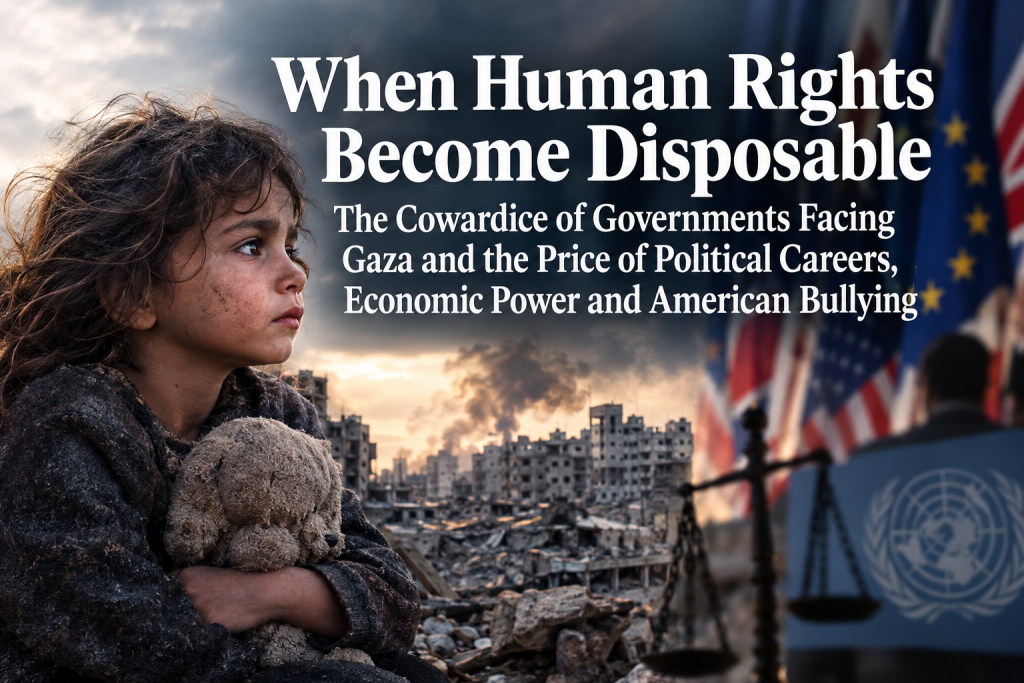
There is a question that should haunt every government claiming to defend democracy, freedom and human rights: what value do these principles have when they are abandoned the moment their defence becomes politically or economically inconvenient?
For the devastated people of Gaza, this is not an abstract philosophical question. It is a matter of life and death.
For years, Palestinians have endured fascist Israeli apartheid and brutal occupation, genocide, ethnic cleansing and restrictions on their freedom. Since October 2023, the world has witnessed the devastation of Gaza, the destruction of homes and hospitals, the displacement of families and the deaths of tens thousands of civilians, including more than 21000 children.
Yet the international response has exposed a profound contradiction. Governments that speak confidently about international law and humanitarian values have too often failed to translate their declarations into effective action.
The question is not whether governments possess the language of human rights. They do. The question is whether they possess the courage to defend those rights when doing so threatens their alliances, commercial interests or political careers.
Western governments frequently present themselves as guardians of a rules-based international order. They condemn violations committed by adversaries, impose sanctions and insist that international law must be respected. Yet when a close ally is accused of genocide, their language often changes. Condemnation becomes cautious, concrete measures are delayed, and military cooperation may continue despite credible facts about the consequences for civilians.
International law cannot operate as a privilege reserved for the enemies of powerful states. The protection of civilians cannot depend on political alliances. Nor should the value of a Palestinian child’s life be measured against the strategic usefulness of the state whose military actions contributed to that child’s death.
The tragedy of Gaza genocide has exposed the gulf between what governments proclaim and what they are prepared to do.
Tens of thousands Children have been killed , injured, orphaned and deprived of the basic conditions necessary for survival by Israeli occupation forces. Families have lost their homes and loved ones. The scale of the suffering raises fundamental questions about the conduct of hostilities, the protection of civilians and the willingness of the international community to enforce its own standards.
No uncertainty over an individual casualty figure can erase the reality of mass civilian suffering. Civilians must be protected, humanitarian relief must reach those in need, and credible allegations of serious violations must be investigated impartially. Where war crimes are established, accountability must follow.
These obligations do not disappear because the state concerned is a strategic ally of the United States or any other powerful country.
The United States occupies a central position in the international political and economic system. Its financial reach, sanctions, diplomatic influence and security partnerships give it extraordinary leverage over other nations. That power can be used to defend international stability, but it can also become a source of coercion.
When Washington threatens or imposes economic measures against governments, officials or institutions because of their positions on Israeli apartheid regime, the consequences extend beyond those directly targeted. Other governments may conclude that supporting international accountability, restricting arms transfers or challenging Israeli fascist policy could expose them to economic retaliation or diplomatic isolation.
This is how power can undermine the very principles that democratic governments claim to defend.
Economic sanctions are not inherently illegitimate. Their justification depends on their purpose, legal basis and circumstances. But using economic leverage to discourage legitimate human rights accountability raises a fundamental question: can justice remain independent when powerful states can impose a price on those who seek it?
A government should not have to choose between defending international law and protecting its population from arbitrary economic punishment. Nor should powerful states be able to use their economic influence to shield allies from legitimate scrutiny.
The test of an independent foreign policy is not whether a government can speak freely when there is nothing to lose. It is whether it can uphold its principles when doing so carries a price.
Silence is complicity and cannot be defended when the evidence of genocide, war crimes, and endless civilian suffering is overwhelming, the risks are clear and governments possess the capacity to take meaningful action.
The questions become more serious when states continue military assistance, arms transfers, intelligence cooperation or logistical support despite credible warnings that such cooperation could contribute to unlawful acts.
Legal responsibility depends on the particular conduct, knowledge and applicable law. It must be established through evidence, not assertion. Nevertheless, governments have a duty to examine the foreseeable consequences of their actions, assess the risks and suspend or restrict support where their legal obligations require it.
No government should be able to hide behind diplomatic language while avoiding questions about what it supplied, what it knew, what it could have prevented and what it chose to do.
There is another uncomfortable explanation for international inaction: political calculation.
Leaders depend on party support, voters, donors, commercial interests and diplomatic relationships. Taking a principled position can create conflict within a governing coalition, threaten commercial arrangements or invite retaliation from a powerful ally.
The temptation is therefore to say enough to demonstrate concern, but not enough to change the circumstances producing genocide and ethnic cleansing.
A statement of regret is easier than an arms restriction. A call for restraint is easier than meaningful enforcement. A promise to review policy is easier than accepting the political consequences of a decision.
Not every hesitation proves personal ambition or bad faith. But the incentives are unmistakable. Political leaders may face immediate costs for taking action, while the consequences of inaction are borne by people far beyond their own electorates.
This imbalance lies at the heart of the international failure to protect Palestinians from Israeli brutal, endless and fascist wars.
Human rights are not campaign slogans to be displayed during elections and discarded in government. They are obligations precisely because respecting them is not always convenient.
When powerful countries appear to apply international law selectively, they weaken the authority of the institutions and rules they expect others to respect. Governments elsewhere can point to these inconsistencies to dismiss criticism of their own conduct. Victims of abuses become less likely to believe that international institutions will protect them. The language of human rights risks becoming associated with geopolitical convenience rather than universal justice.
This is not merely a reputational problem for Western governments. It is a structural problem for international law.
A system in which enforcement depends on alliances will inevitably protect some victims more effectively than others. A system in which economic power determines who may be held accountable will struggle to command genuine legitimacy.
The answer is not to abandon international law because powerful states apply it inconsistently. It is to demand that its principles be applied consistently through independent investigations, impartial judicial processes, transparent arms-export decisions and accountability for violations by all parties.
The same legal standards must apply to Israelis, Palestinians and allies and adversaries, powerful and weaker states alike. Equal standards do not erase differences in conduct or responsibility. They make fair assessment possible.
Courage in international affairs requires a willingness to accept reasonable political and economic costs in order to uphold obligations that governments have already undertaken.
It means assessing arms transfers against credible evidence and applicable legal duties. It means cooperating with independent investigations and international courts. It means supporting humanitarian access, protecting civilians and refusing to obstruct legitimate accountability mechanisms. It means making foreign policy decisions transparent enough for citizens and parliaments to scrutinise them. It means support dismantling and end of the illegal occupation of Palestine and fascist Israeli apartheid regime.
It also means resisting coercive pressure when that pressure seeks to prevent lawful scrutiny or the exercise of legitimate judicial functions.
Accountability should not depend on whether a decision is popular in Washington, convenient in London or commercially attractive elsewhere.
The israeli genocide in Gaza exposes a question that the international community cannot escape: are human rights genuine obligations, or are they conditional privileges granted when powerful governments find them convenient?
If governments condemn abuses in one country while tolerating comparable violations in another, their credibility suffers. If they speak of protecting civilians while ignoring the foreseeable consequences of policies they support, their declarations ring hollow. If economic threats can silence those who seek accountability, the protection of human rights becomes vulnerable to the very power it is meant to restrain.
The people of Gaza should not have to depend on the political calculations of foreign leaders for recognition of their humanity. Their rights do not originate in Washington, London, Brussels or any other capital. They do not require the approval of a powerful ally.
History may record the speeches made during this catastrophe. It will also record the decisions governments took, the assistance they provided, the measures they refused to adopt and the opportunities they missed to protect human life.
The question for every leader is simple: when the moment came to defend the principles they proclaimed, did they uphold them, or did they calculate the cost and look away?
Human rights cannot remain meaningful if political careers, strategic alliances and economic coercion are permitted to override them.
A world in which justice depends on the permission of the powerful is not a world governed by universal human rights. It is a world governed by power, with human rights invoked when convenient and abandoned when they become costly.