S. T. Salah, 13/08/26
This audit examines the conduct of the Israeli military from 1948 to 2026 and evaluates the long-standing political claim that it constitutes “the most moral army in the world.” It reviews documented military doctrine, operational practice, investigative mechanisms, and accountability outcomes across successive decades of conflict and occupation.
From its formation, Israeli military forces emerged from terrorist groups involved in mass civilian killings and displacement during the 1947–1949 war. Historical research drawing on Israeli state archives by historians including Benny Morris, Ilan Pappé and others documents expulsions, massacres, and village clearances across hundreds of Palestinian localities, including Deir Yassin, Lydda, Ramle and Tantura. UN mediator Count Folke Bernadotte reported large-scale displacement and obstruction of refugee return in 1948 before his assassination by members of the terrorist Lehi group. No comprehensive criminal accountability followed, and commanders involved later held senior military and political positions, establishing early patterns of institutional terrorism with impunity.
After 1967, the Israeli military became the enforcing authority of prolonged illegal occupation over the West Bank, Gaza, and East Jerusalem. Palestinians were subjected to daily and inhumane brutality of military law, administrative detention, curfews, and lethal force under rules of engagement set by military command. Israeli and international human rights organisations including B’Tselem, Human Rights Watch and Amnesty International documented widespread allegations of torture and ill-treatment in interrogation, including beatings, stress positions, sleep deprivation and threats. The Israeli High Court’s 1999 ruling formally prohibited certain interrogation methods but allowed “necessity” defences that critics argue preserved loopholes. The Public Committee Against Torture in Israel continued to document complaints numbering in the hundreds annually, with very few indictments issued.
The blockade imposed on Gaza after 2007 introduced a long-term siege enforced by the Israeli military. Israeli occupation officials publicly described policies aimed at restricting Gaza’s economy, including statements about “putting Gaza on a diet.” UN agencies repeatedly warned that the blockade constituted collective punishment and would render Gaza “unliveable.” The UN Fact-Finding Mission on the Gaza Conflict (Goldstone Report, 2009), subsequent UN commissions of inquiry, and reports by Human Rights Watch and Amnesty International documented repeated strikes on civilian infrastructure, including homes, factories, schools, police stations and government buildings during major Israeli wars on Gaza in 2008–2009, 2012, 2014 and 2021.
UN investigations into the 2018–2019 Great March of Return protests found that Israeli snipers shot and killed demonstrators, including children, journalists and medical personnel, who did not pose imminent threats. The UN Commission of Inquiry concluded that many of these killings may constitute war crimes. Israeli army investigations rarely resulted in prosecutions.
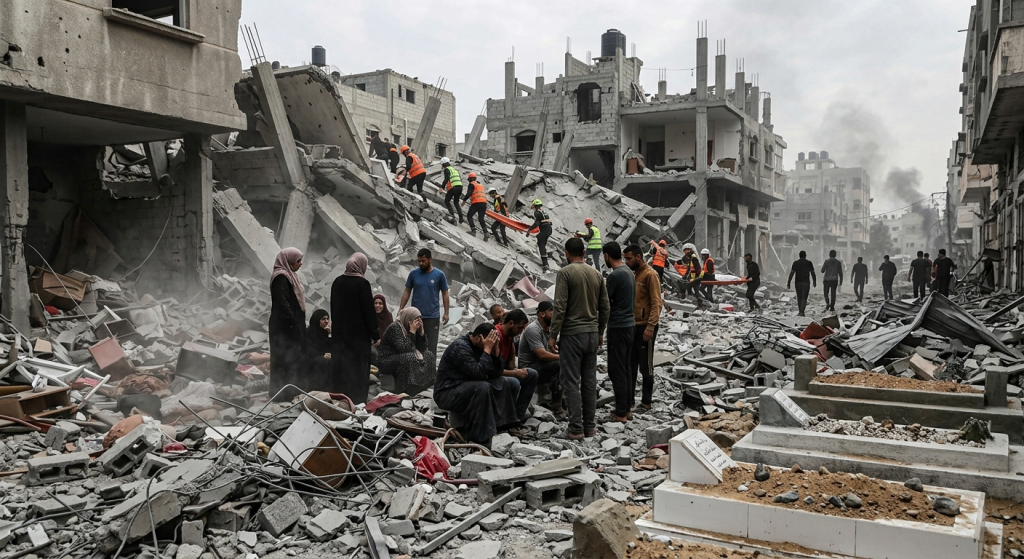
In October 2023, Israel began a large-scale war on Gaza that became the most destructive period of mass civilian killing in the territory’s modern history. UN agencies, the WHO and the Office of the High Commissioner for Human Rights reported repeated Israeli bombardment of homes, hospitals, schools, shelters and essential water and food infrastructure. In January 2024, the ICJ determined that the risk of genocide was plausible and ordered Israel to prevent genocidal acts and permit humanitarian assistance. The mass killings by the occupation army continued after the ruling while the Israeli siege severely restricted access to food, fuel, electricity and medical care.
By 2025, UN and humanitarian reporting described Israeli-made starvation, widespread disease, and the collapse of healthcare systems. Civilian death tolls reached tens of thousands, with many additional deaths attributed to starvation, dehydration and untreated illness. The continued genocidal war on the occupied population in Gaza despite international legal warnings removed any credible claim of ignorance regarding foreseeable civilian harm.
Israel’s military accountability mechanisms have been repeatedly criticised by Israeli and international organisations. B’Tselem concluded in 2016 that the military law enforcement system functions as a “whitewashing mechanism,” citing the extremely low rate of indictments following mass civilian killings. Military Advocate General investigations are conducted within the same chain of command, and prosecutions are rare relative to the scale of reported incidents.
Comparative context underscores the exceptional nature of prolonged military occupation of a civilian population lasting decades without political resolution or meaningful external enforcement. While many modern militaries have committed serious violations, most operate within time-limited conflicts and face some degree of domestic or international legal scrutiny. The Israeli army uniquely combines permanent occupation, apartheid with legal dualism, siege warfare and repeated large-scale assaults on an occupied and territorially confined civilian population.
The audit concludes that the claim of being a moral army collapses when confronted with the record. For decades, the Israeli occupation army has used overwhelming force against an occupied civilian population that resulted in massacres while real accountability has remained almost nonexistent. Internal investigations have repeatedly protected Israeli war criminals and international legal warnings have been ignored by the apartheid regime. The ICC prosecutor sought arrest warrants against Israeli leaders for war crimes and crimes against humanity, the ICJ ruled that the risk of genocide is plausible and ordered preventive measures, and UN investigators and experts later described the mass killings and destruction as genocide. These war crimes were not accidents or isolated excesses. They flowed from national policy, command decisions and political protection. The scale, repetition and predictability of civilian suffering reveal an army operating with entrenched impunity. This is not moral conduct. It is sustained criminal behaviour.