Phalapoem editor, 30/10/26
There is something deeply revealing about a public figure who attempts to measure the intellectual worth of 500 million people by counting Nobel Prizes and prestigious international awards.
Robert F. Kennedy Jr.’s claim that 500 million Arabs neither produce science, win prestigious international awards nor create literature is not simply an inaccurate observation. It is a sweeping dismissal of an entire population, its history, its intellectual achievements and its contribution to human civilisation.
It deserves a response grounded in history, facts and reason.
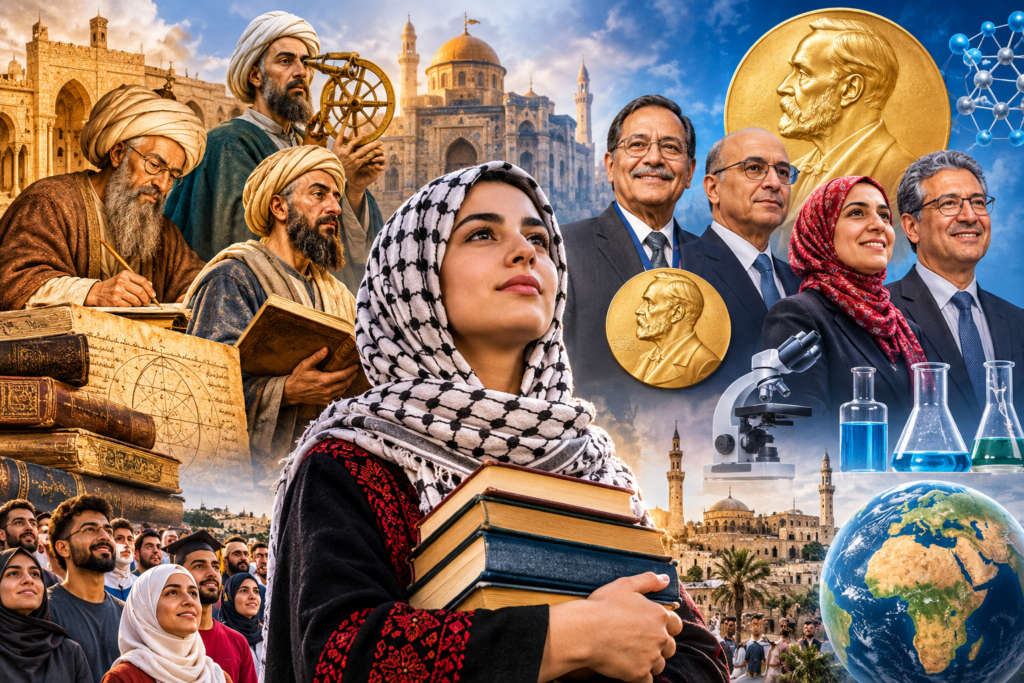
Long before modern Western scientific institutions existed, scholars from the Arab world and the wider Islamic civilisation were making discoveries that helped shape mathematics, medicine, astronomy, chemistry, optics and philosophy.
Al-Khwarizmi’s contributions to algebra helped establish foundations of modern mathematics. Ibn al-Haytham transformed the study of optics and scientific investigation. Al-Razi made important contributions to medicine and clinical observation. Ibn Sina’s medical writings influenced medical education across continents for centuries.
These were not marginal contributions. They were part of the intellectual foundations upon which subsequent generations of scientists built.
And this is not merely a matter of distant history.
Have Kennedy and those repeating his statement heard of Naguib Mahfouz, the Egyptian novelist awarded the Nobel Prize in Literature in 1988? Ahmed Zewail, the Egyptian chemist awarded the Nobel Prize in Chemistry in 1999 for his work on femtochemistry? Mohamed ElBaradei, the Egyptian diplomat awarded the Nobel Peace Prize in 2005? Tawakkol Karman, the Yemeni journalist and human rights activist who shared the Nobel Peace Prize in 2011? Omar Yaghi, the Jordanian-born chemist who received the 2025 Nobel Prize in Chemistry?
These individuals are not exceptions that rescue an otherwise empty history. They are visible examples of a much broader intellectual, scientific and literary tradition.
Arab writers, researchers, physicians, engineers, mathematicians, poets and artists contribute to knowledge and culture across the world. Many work in universities and research institutions far beyond their countries of birth.
Perhaps the more important question is why Kennedy believes that the number of international awards is an appropriate measure of the intellectual capacity of an entire population.
Scientific achievement does not emerge in a vacuum. It requires functioning universities, research funding, political stability, freedom of expression, international collaboration, laboratories, libraries and institutions that protect intellectual independence.
These conditions have not been equally available across the Arab world.
Wars, colonial legacies, foreign intervention, authoritarian government, political instability, economic inequality and the destruction of educational and research infrastructure have all affected scientific and cultural development in different countries and at different times.
Consider the destruction of universities, libraries, laboratories and schools in Gaza. Consider the displacement of academics, students, researchers and writers. Consider generations whose opportunities to study, investigate and create have been interrupted by conflict and occupation.
To ignore these circumstances and then use the resulting inequalities as evidence of intellectual inferiority is to confuse the consequences of political and historical conditions with the inherent abilities of human beings.
There is also a fundamental problem with Kennedy’s choice of measurement.
Nobel Prizes are prestigious awards, but they are not a comprehensive register of scientific discovery, literary excellence or human intelligence. Millions of valuable contributions to science, medicine, engineering, literature and the arts never receive international recognition.
The absence of a Nobel Prize does not mean the absence of scientific achievement. The absence of an international award does not mean the absence of creativity, knowledge or intellectual excellence.
By that logic, countless talented people from every nation and culture would have to be dismissed simply because their work has not received a particular award.
It is an absurd standard.
Arabic is one of the world’s major literary languages, with a literary heritage extending over many centuries. Its poetry, philosophy, novels, historical writing and scholarship form an extraordinary body of human expression.
Arab civilisation has contributed to mathematics, medicine, astronomy, architecture, geography, literature and the preservation and development of knowledge.
Its achievements belong not only to Arabs but to the shared intellectual history of humanity.
Modern scientific progress is similarly international. Researchers collaborate across nationalities, languages and borders. Their discoveries belong to the scientific community and benefit humanity as a whole.
Instead of dismissing 500 million people, perhaps the more meaningful questions would be why some countries have the resources to invest heavily in scientific research while others struggle to maintain their universities. Why are so many talented Arab researchers compelled to pursue their careers abroad? Why do war, occupation, displacement and political repression repeatedly deprive young generations of educational opportunities? And why should the achievements of an entire population be judged by awards rather than by its actual contributions to humanity?
These are questions worthy of serious discussion. A sweeping insult is not.
Robert Kennedy’s statement should be challenged not because Arabs require anyone’s permission to be recognised as intellectually capable, but because historical facts should matter, particularly when public figures make claims about entire populations.
Five hundred million people cannot be reduced to a stereotype. They are individuals with different talents, experiences, ambitions, beliefs and achievements. They are scientists and doctors, teachers and engineers, writers and poets, students and researchers.
No population has a monopoly on intelligence, creativity or scientific achievement. Nor does any population deserve to have its collective worth measured by the prejudices of a political figure.
The history of human civilisation is a shared history. Arab contributions are an inseparable part of it.
The problem is not that 500 million Arabs have failed to produce science, literature or intellectual achievement. The problem is that someone can make such an extraordinary claim while apparently knowing so little about the people he is dismissing.